
If you sell, buy, or use WordPress plugins and themes, you’ve probably asked this important question:
Is GPL legal for WordPress?
The short answer is: Yes — 100% legal.
But to fully understand why, you need to know how the GPL license works, why WordPress uses it, and what it means for developers, store owners, and digital entrepreneurs.
This comprehensive guide explains everything in detail and is fully optimized for SEO.
What Is GPL?
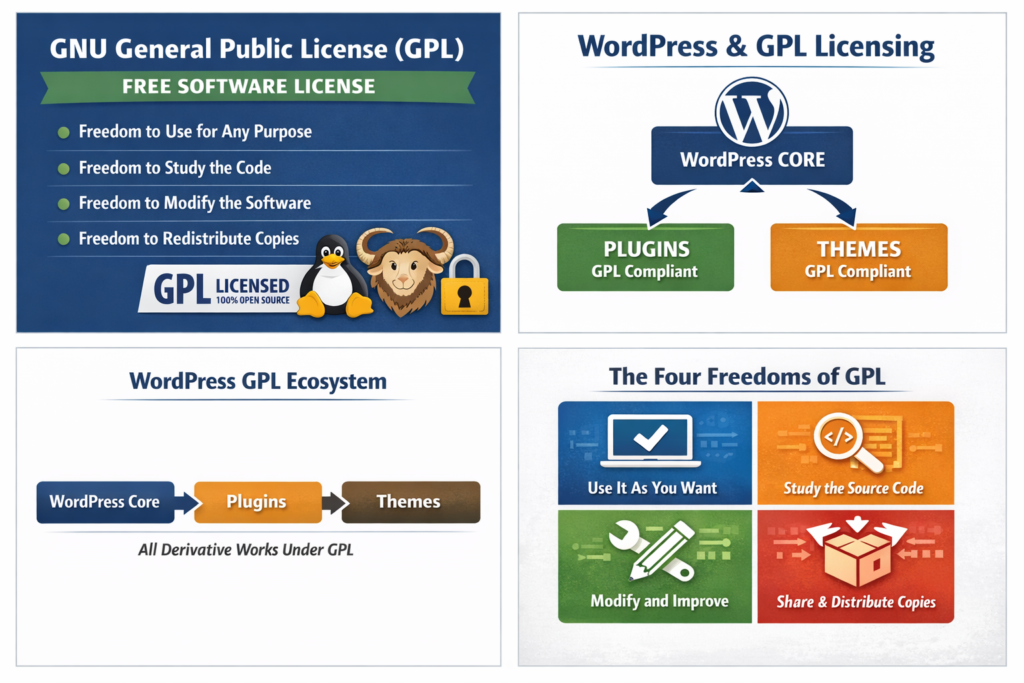
The GNU General Public License (GPL) is an open-source software license designed to guarantee users four essential freedoms:
- The freedom to use the software for any purpose.
- The freedom to study how it works.
- The freedom to modify it.
- The freedom to redistribute original or modified copies.
GPL was created to protect software freedom and ensure that open-source projects remain open forever.
Why Does WordPress Use GPL?
The core of WordPress is fully licensed under GPL.
This means:
- Any derivative work must also comply with GPL.
- Plugins that rely on WordPress core functions are considered derivative works.
- Themes that integrate with WordPress fall under the same principle.
In other words, GPL is not optional within the WordPress ecosystem — it is foundational.
Is GPL Legal for WordPress?
Yes. Absolutely.
Because WordPress itself is GPL-licensed, anything that extends or interacts deeply with its PHP core must also respect GPL terms.
This is not a loophole or grey area — it is the legal structure that governs the entire WordPress ecosystem.
Does GPL Mean “Free of Charge”?
No — and this is where many people get confused.
GPL means freedom, not “free price.”
You are legally allowed to:
- Sell GPL software
- Resell GPL software
- Bundle GPL products
- Modify and redistribute them
You can charge money for:
- Development time
- Convenience
- Technical support
- Automatic updates
- Hosting and setup services
This is why many marketplaces sell GPL plugins and themes at discounted prices.
Real-World Example
A well-known plugin like WooCommerce operates under GPL licensing.
That means anyone can:
- Download it
- Modify it
- Redistribute it
The same applies to popular SEO plugins like Rank Math (the free version is entirely GPL).
GPL vs Commercial Licensing
Some companies sell WordPress products under “commercial licenses.” However, what they are actually selling is:
- Access to updates
- Access to official support
- API services
- Membership benefits
They cannot restrict your legal right to use or redistribute the GPL-licensed code itself.
The code remains GPL — the services are what you pay for.
Can You Legally Sell GPL Plugins?
Yes.
Selling GPL plugins is fully legal provided that:
- You do not falsely claim authorship.
- You do not misuse trademarks.
- You clearly state that the product is GPL-licensed.
For example, you cannot use the official WordPress logo without permission from the WordPress Foundation.
Trademark law is separate from GPL licensing.
What About WordPress Themes?
WordPress themes are also considered derivative works because they rely on WordPress core functions.
Therefore:
- The PHP code must be GPL.
- CSS, images, and JavaScript may technically use different licenses, but most professional themes adopt GPL fully for simplicity and compliance.
This ensures legal clarity and avoids potential disputes.
Does GPL Affect SEO?
From an SEO perspective, GPL has no negative impact whatsoever.
Search engines do not care about licensing.
What matters for SEO is:
- Code quality
- Page speed
- Security
- Mobile optimization
- Structured data
However, there is one important warning:
Downloading GPL products from unreliable sources can result in:
- Malware
- Hidden backlinks
- Spam injections
- Backdoors
These can severely damage your SEO rankings and website credibility.
Always verify your source.
Why Do Some Companies Oppose GPL Reselling?
The opposition is usually business-related — not legal.
Many companies rely on:
- Recurring subscriptions
- Customer support plans
- SaaS integrations
- Licensing keys
When GPL products are resold, it may reduce direct sales — but legally, redistribution is allowed.
This tension is economic, not legal.
The Legal Foundation of WordPress
WordPress grew into the world’s largest CMS because of GPL.
Open licensing enabled:
- Community contributions
- Plugin ecosystem expansion
- Global development collaboration
- Affordable access for startups and small businesses
Without GPL, WordPress would not have scaled the way it did.
Key Takeaways
Is GPL legal for WordPress?
✔ Yes — completely legal
✔ WordPress core is GPL
✔ Plugins and themes must comply
✔ You can legally sell GPL products
✔ Trademark rules still apply
✔ SEO is unaffected by GPL
Understanding GPL gives you a competitive advantage if you operate a digital products store or WordPress service business.
Recommended Images for SEO Optimization
To improve engagement and search visibility, include the following visuals in your article:
1️⃣ GPL License Graphic
Alt Text: “GNU General Public License explained”
2️⃣ WordPress Licensing Structure Diagram
Alt Text: “How GPL applies to WordPress core plugins and themes”
3️⃣ WordPress Ecosystem Flowchart
WordPress Core → Plugins → Themes
Alt Text: “WordPress derivative works under GPL”
4️⃣ GPL Four Freedoms Infographic
Alt Text: “The four freedoms of open-source software”


 No products in the cart.